
In modern banking environments, branch offices, ATMs, self-service terminals, and cloud systems are highly distributed. The network must simultaneously handle transaction data, video surveillance, and real-time financial services. Any latency or service disruption can directly impact transaction reliability and erode customer trust. However, traditional WAN architectures often suffer from high costs, limited flexibility, and complex management, making them increasingly inadequate to support the financial sector’s demand for 24/7 uninterrupted services and rapidly growing data traffic.
By adopting an SD-Branch architecture, banks can consolidate distributed branch networks into a unified management platform, while extending the intelligence of SD-WAN across the entire branch infrastructure to enable centralized management and dynamic traffic orchestration. This architecture effectively integrates WAN, LAN, and security capabilities, and when combined with centralized management and the SASE security framework, becomes a key solution for driving branch network transformation in the financial sector. It not only improves bandwidth utilization and connection stability, but also significantly reduces network operating costs, while comprehensively strengthening cybersecurity protection.
.
Portwell’s Next-Generation SD-Branch Solutions
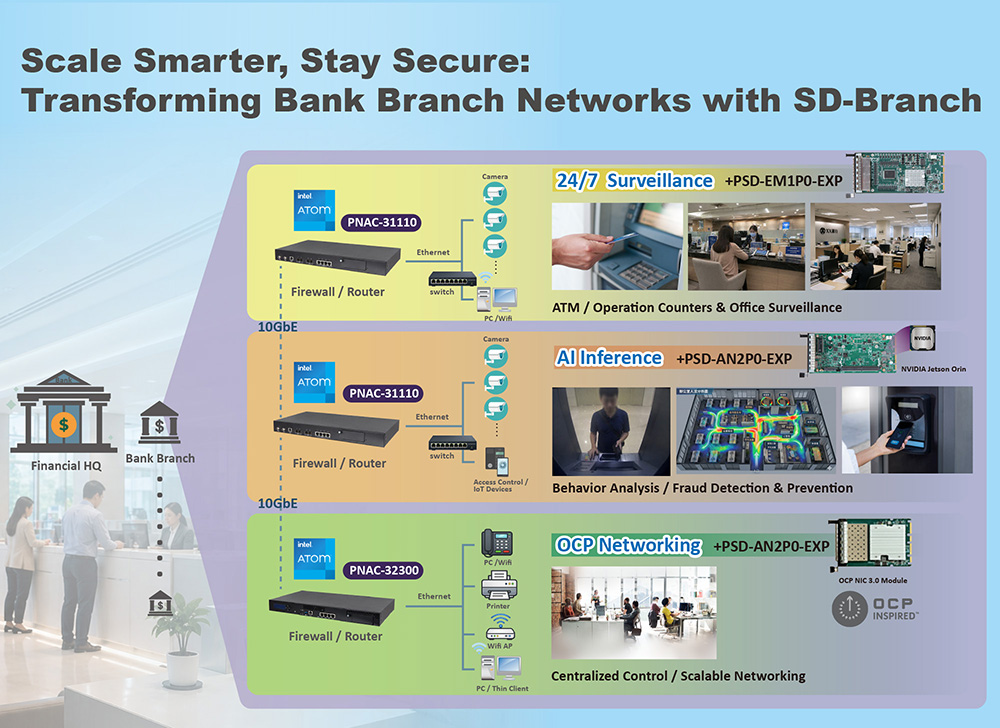
PNAC-32300 is a 1U rackmount SD-Branch solution built on the Intel® Atom™ x7809C platform, designed for deployment at banking headquarters, regional offices, or aggregation sites as a distributed node within the SD-Branch architecture. It features four 2.5GbE network interfaces with bypass functionality, ensuring highly reliable network connectivity even during system maintenance or failures. In addition, the platform supports an OCP 3.0 expansion module, providing flexibility for future network or service expansion. Within SD-Branch deployments, PNAC‑32300 is well suited for handling functions such as local traffic aggregation, secure VPN connectivity, and policy-based security enforcement.
Also positioned as an SD-Branch extension node, PNAC-31110 is optimized for deployment at branch offices or edge environments that demand high-performance packet processing. Based on the Intel® Atom™ C3758R platform, it supports DPDK and QAT acceleration technologies, delivering the low latency and high throughput required in financial transaction-intensive scenarios. To further enhance availability in mission-critical environments, the system is equipped with dual DC power inputs, while an M.2 expansion slot enables integration of wireless communication modules for flexible connectivity. PNAC-31110 incorporates Portwell’s proprietary expansion interface, developed in compliance with the OCP 3.0 SFF specification, enabling seamless integration of application-specific expansion modules such as PoE+ cards and AI acceleration modules. This modular architecture enables scalable and customized network expansion, allowing banks to adapt system capabilities to diverse branch deployment requirements.
Overall, this SD-Branch solution simplifies deployment, reduces costs, and enhances efficiency while optimizing architecture and strengthening edge security to address network complexity, operational challenges, and cybersecurity risks.
Enabling Intelligent Financial Branches with AI and PoE Expansion Modules
Built upon the SD-Branch infrastructure, the PSD-AN2P0-EXP and PSD-EM1P0-EXP expansion modules transform the platform into an intelligent financial edge node, further enhancing digital transformation value for banks.
Enhanced AI-Driven Security and Anomaly Detection
With the PSD-AN2P0-EXP expansion card integrating the NVIDIA Jetson Orin AI accelerator, the system provides a complete driver stack and AI development environment, supporting deployment and inference of multiple AI models. This enables AI capabilities to be deployed directly at branch or edge locations for network traffic behavior analysis, anomaly detection, and real-time threat identification.
By reducing reliance on cloud computing, this architecture significantly shortens response times to security incidents while meeting the financial industry’s stringent requirements for real-time protection and high reliability.
In practical applications, the AI expansion solution supports a wide range of financial scenarios, including:
Integrated Branch Networking and Surveillance Deployment
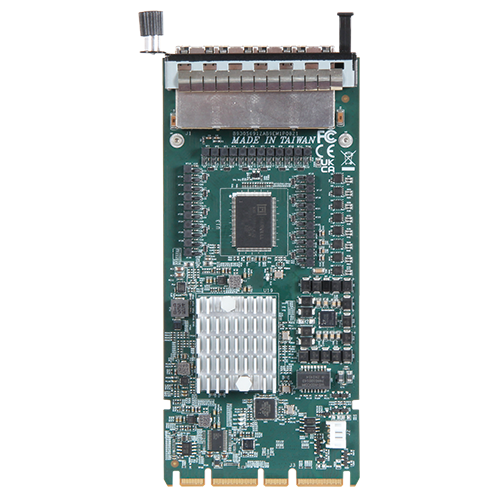
PSD-EM1P0-EXP is an 8-port Layer 2 switch expansion card with PoE+ support, delivering up to 60W of total PoE power. It enables stable power supply and network connectivity for multiple IP cameras, Wi-Fi access points, and ATM peripheral devices. In financial applications, this module can be directly deployed at branch sites, replacing external switches and PoE power devices. It supports direct connection to surveillance cameras and wireless access points, enabling applications such as ATM monitoring, customer behavior analysis, and fraud detection. This not only simplifies network architecture and reduces cabling complexity, but also lowers deployment costs and accelerates rollout across branch locations.
Modular Scalability for Long-Term Financial Infrastructure Evolution
Whether based on the standard OCP 3.0 architecture or Portwell’s proprietary ETSFF design, the SD-Branch platform offers flexible integration of networking and compute acceleration modules to meet diverse deployment requirements. This modular approach enhances system scalability and upgrade flexibility, improves deployment efficiency, and helps extend product lifecycle while reducing total cost of ownership, making it particularly well-suited for financial network environments that demand long-term stability and reliability.
SD-Branch has become the mainstream architecture for modern banking branch networks. By integrating AI capabilities and switching expansion, the PNAC-32300 and PNAC-31110 not only address long-standing challenges in cost, performance, and cybersecurity, but also enable banks to transition from traditional network infrastructures to next-generation digital financial platforms that are intelligent, highly visible, and capable of real-time decision-making.
Para ofrecer las mejores experiencias, utilizamos tecnologías como cookies para almacenar y/o acceder a la información del dispositivo. Dar su consentimiento a estas tecnologías nos permitirá procesar datos como el comportamiento de navegación o identificadores únicos en este sitio. No dar o retirar el consentimiento puede afectar negativamente ciertas funciones y características.